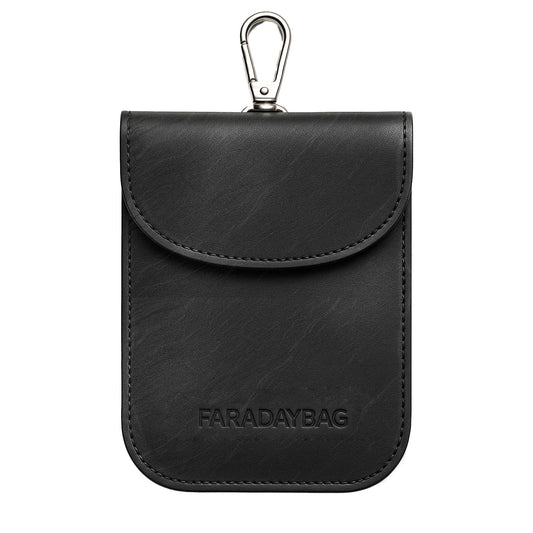
A Faraday cage is any conductive enclosure that shields its interior from electromagnetic fields: the conductive shell redistributes incoming fields around the outside, so radio signals can't reach what's inside — and can't escape from it either. Demonstrated by Michael Faraday in 1836, the principle scales from room-sized lab chambers down to the Faraday bag in your pocket. Below: how it actually works, which everyday objects are (and aren't) Faraday cages, whether grounding matters, and how to build or buy one.

How a Faraday Cage Works
When an electromagnetic field hits a conductor, the conductor's free electrons rearrange to cancel the field inside the material. Wrap that conductor fully around a space, and the space inside stays field-free — the classic demonstration is a person sitting safely inside a cage while artificial lightning strikes it.
Two rules decide whether a real-world cage works:
- Continuity. The shield must fully enclose the space. Gaps, seams and loose lids leak — most failed builds fail here, not in the material.
- Mesh size vs wavelength. A cage doesn't need to be solid metal: mesh works as long as the holes are much smaller than the wavelength being blocked. Fine mesh (a few millimetres) blocks Wi-Fi and cellular; chicken wire with 25 mm holes leaks badly at those frequencies.
Everyday "Faraday Cages": Real, Partial and Fake
This is where most explanations go wrong, so here's the honest scorecard:
| Object | Is it a Faraday cage? | Why |
|---|---|---|
| MRI room / lab test chamber | Yes | Purpose-built continuous shielding, tested to standards |
| Faraday bag or pouch | Yes, when sealed | Conductive fabric + a complete fold-over seal |
| Microwave oven | Partial | Designed to contain 2.4 GHz; phones on other bands often still get signal inside — test yours |
| Car body | No | Windows, plastic panels and deliberate antenna paths — your phone working in the car is the proof |
| Elevator | Accidental, unreliable | Signal drops come from metal surroundings, not a designed shield |
| Aluminium foil wrap | Temporary | Three+ tight layers pass the call test, but foil tears and degrades with reuse |
Does a Faraday Cage Need to Be Grounded?
No — this is the most persistent myth. Shielding works by charge redistribution in the conductive shell, grounded or not. Grounding matters for static discharge in large walk-in installations, but a Faraday bag, box or tin blocks radio signals exactly the same whether or not anything connects it to earth. (More short definitions like this in our glossary.)
What People Use Faraday Cages For
- Blocking car-key relay theft — a shielded pouch or box stops thieves extending your fob's signal to the car. The data on how relay theft actually works.
- Location privacy — a sealed phone can't reach towers, Wi-Fi or GPS. What a shield does and doesn't stop, per Apple's own documentation.
- Lab and medical isolation — MRI rooms and EMC test chambers exist so measurements aren't polluted by outside signals.
- Evidence preservation — forensics teams shield seized devices so they can't be wiped remotely.
- Preparedness storage — spare electronics in a sealed metal container as part of an emergency kit.

Build One or Buy One?
Build if you want volume on a budget or enjoy the project: a metal container with a sealed lid is a genuine Faraday cage, and our step-by-step build guide covers three methods plus the mistakes that make most DIY cages fail. The materials we actually sell for it: conductive shielding fabric and EMI seam tape.
Buy if you want something you'll use daily: a phone bag, key fob pouch or larger shielded bag is the same physics in a carryable form. Unsure which? The Bag Finder answers it in one question.
Test Any Cage in 30 Seconds
- Put a phone inside and close the enclosure completely.
- Call it from another phone.
- No ring = working cage. A ring means there's a gap, a bad seam, or the material isn't conductive enough.
This works on a biscuit tin, a DIY mesh box, a commercial bag — anything. It's also the test we invite you to run on our own products on day one.
Frequently Asked Questions
Who invented the Faraday cage? Michael Faraday demonstrated the principle in 1836, building on earlier observations by Benjamin Franklin. The name has stuck for nearly two centuries.
Can a Faraday cage block an EMP? A sealed all-metal enclosure is the standard preparedness approach, and nesting (foil-wrapped devices inside an insulated metal box) adds margin — but no home build or consumer product can be verified against a real pulse outside a specialised lab, and we won't pretend otherwise.
Does a Faraday cage block sound or magnets? No. It shields electromagnetic radio waves. Sound is pressure, and static magnetic fields (like a fridge magnet's) pass through — different physics, different shielding.
What's the difference between a Faraday cage and a Faraday bag? Scale and form only: the bag is the flexible, sealable, pocket-sized version of the same principle. See What is a Faraday bag? for that side of the story.
Keep Reading
How to make a Faraday cage (3 builds) · Does a Faraday bag really work? · Glossary · Knowledge base · What we do and don't claim