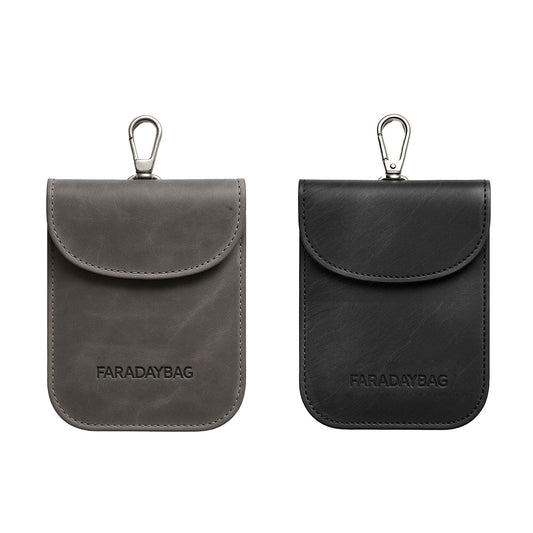
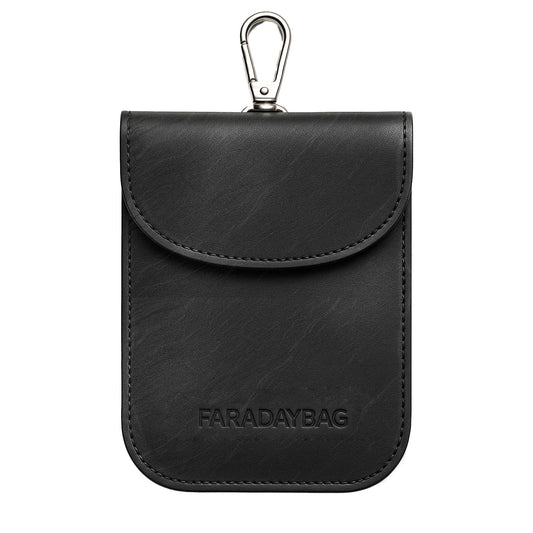
Choosing a Faraday bag comes down to four things: it has to be big enough for your device with room to fold the closure, the closure has to seal completely, the shielding has to survive daily handling, and — most importantly — you have to be able to verify it yourself. Everything else in Faraday-bag marketing is either a number you cannot check or a feature you probably do not need. Here is how to tell the difference.
1. Size: Measure the Fold, Not Just the Device
The single most common mistake is buying a bag that technically fits. A Faraday bag closes by folding the opening over on itself two or three times — that fold is the seal. If your device fills the bag to the top, there is nothing left to fold, and the bag leaks.
Measure your device with its case on, then allow several centimetres of spare height above it. If you are between sizes, go up. A phone in a document-sized bag still works; a laptop crammed into a phone pouch does not.
2. The Closure Is the Whole Product
Shielding fabric is widely available and broadly similar between brands. The closure is where bags actually differ, and where they fail. Look for a stiffened fold-over strip with a full-width hook-and-loop or magnetic seal that runs edge to edge — a closure that stops short of the seams leaves a gap at each corner.
Closures also wear out. Hook-and-loop fills with lint, stitching loosens, and a bag that sealed perfectly a year ago may not today. This is the main reason to re-test a bag you have owned for a while rather than assume it still works.
3. Decoding the Claims You Will See
This is the part most buying guides skip, so here it is plainly:
- A dB attenuation figure (for example ">80 dB") is meaningful only if the brand names the standard and the lab. A number with no source behind it is marketing copy.
- MIL-STD-188-125 is a real US military standard for high-altitude EMP protection of fixed facilities. Brands citing it are referencing a genuine test method — but a consumer pouch is not a hardened facility, and compliance of the fabric is not the same as certification of the finished bag.
- "Military-grade" with no standard named means nothing. There is no such certification.
- "100% blocking" is a claim no honest brand should make about a soft, foldable, hand-closed product, because performance depends on how you close it.
- Fireproof and waterproof ratings are separate from signal blocking. A bag can be excellent at one and unremarkable at the other. Ask which certification covers which property.
For what each of these terms means in more detail, see our glossary. For how the major brands' published claims compare side by side — including where ours fall short of theirs — see our brand comparison.
4. Verify It Yourself in 30 Seconds
You do not have to take anyone's word for it, including ours. On the day your bag arrives:
- Put a phone inside and fold the closure fully shut.
- Call that phone from another phone.
- No ring means the bag is working. A ring means there is a gap — usually an incomplete fold, or a device packed too tightly.
Repeat it every few months, and after anything that stresses the closure. Our full 5-step test guide covers GPS, Wi-Fi and Bluetooth checks as well, which matter if you are shielding a tracker rather than a phone.
What We Can and Cannot Tell You
We build and sell these bags, so treat this section as the one where our interest is obvious. Our published test pack has a lab shielding test of our conductive fabric by the Beijing Institute of Radio Metrology & Measurement — on a fabric sample, not a sealed bag, and only from 10 MHz to 1.5 GHz, below Wi-Fi, Bluetooth and most cellular bands, so we don't turn it into a headline rating for the bags. Its SGS fire test was on our leather; our fiberglass bags have a fire-resistant shell, not a fire certificate. If a finished-bag test across Wi-Fi and cellular bands is your deciding factor, several competitors publish one and we say so openly in our comparison.
What we would rather you rely on is the test above, which costs you nothing and works on any brand.
Which Bag for Which Job
Once you know what to look for, picking is straightforward. Our current picks by use case — phone, car keys, laptop, documents and budget — live on the Best Faraday Bags page, with real sizes and prices on each product. If you would rather answer one question and be pointed straight at the right size, use the Bag Finder.
Keep Reading
How to test a Faraday bag at home · Mission Darkness vs GoDark vs SLNT vs us · What we do and don't claim · Knowledge base