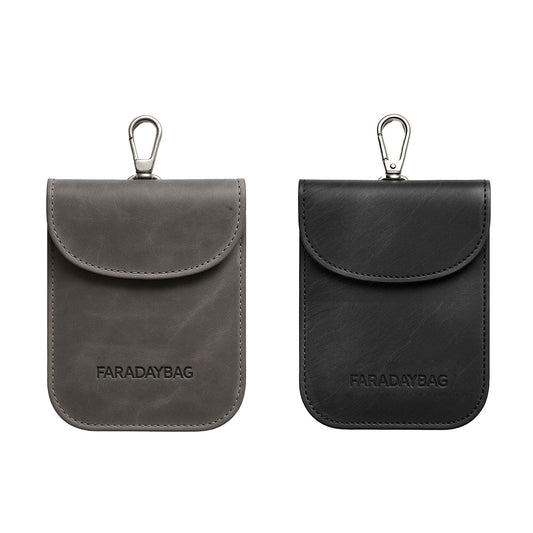
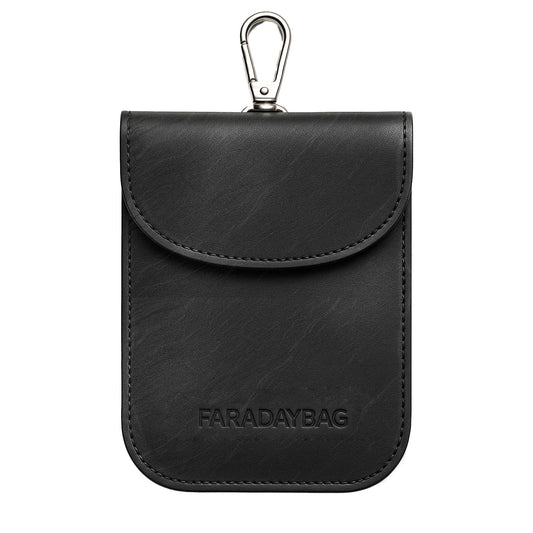
A Faraday bag is a pouch lined with conductive fabric that blocks wireless signals — cellular, Wi-Fi, GPS, Bluetooth and RFID — from reaching whatever you seal inside, and stops that device transmitting out. It needs no battery, no app and no setup: the shielding is woven into the fabric, and it works for exactly as long as the bag stays fully sealed. Below: how it works, what it does and doesn't do, how to test one in 30 seconds, and how to pick the right size.
How Does a Faraday Bag Work?
It's a portable Faraday cage. In 1836, Michael Faraday demonstrated that a conductive enclosure redistributes electromagnetic fields around its outside, leaving the interior shielded. A Faraday bag applies the same physics with flexible metallised fabric — typically layers woven with copper and nickel — instead of a rigid metal box.
Two practical rules follow, and they explain almost every "my bag doesn't work" complaint:
- The enclosure must be complete. Signal leaks through openings, which is why the fold-over or roll-top seal matters more than the fabric itself. An unsealed Faraday bag is just a bag.
- Shielding is passive and two-way. Nothing gets in (no calls, pings, or tracking requests reach the device) and nothing gets out (the device can't report its position). There is no battery to die and nothing to switch on.
What It Blocks — and What It Doesn't
Blocks, when fully sealed: cellular (all generations, 5G included), Wi-Fi, Bluetooth, GPS reception, and RFID/NFC. That includes the Bluetooth beacon that lets a switched-off iPhone stay findable — per Apple's own documentation, a powered-off iPhone can be located for up to 24 hours, which is precisely the kind of transmission only a physical shield stops.
Doesn't do: it can't remove spyware (malware records locally and uploads when the device comes out), can't erase location history that was already sent, and only protects while the device is inside. We'd rather you know that before buying — more in what we do and don't claim.
Bag, Pouch, Box or Cage — What's the Difference?
| Term | What it means | Typical use |
|---|---|---|
| Faraday bag | Any soft, sealable shielding enclosure | Phones, laptops, documents |
| Faraday pouch | Same thing, smaller — the words are interchangeable | Phones, car key fobs |
| Faraday box | A rigid shielded container that stays put | Key fobs at home, entryway storage |
| Faraday cage | The general principle — any conductive enclosure, up to room size | Labs, MRI rooms, DIY builds |
What People Actually Use Them For
- Stopping car relay theft — the most concrete use. Thieves extend a key fob's signal from inside your house to your car; a sealed pouch breaks the chain. The data on how relay theft works and how common it is.
- Location privacy on demand — a sealed phone can't connect to towers, Wi-Fi or GPS, so it can't report where it is.
- Protecting cards and passports from close-range scanning — though for payment cards specifically, read the honest data first; the threat is smaller than the marketing suggests.
- Digital detox — genuinely unreachable beats silenced.
- Evidence preservation — digital-forensics teams have used shielded enclosures for years so seized devices can't be remotely wiped.
- Preparedness storage — sealed spare electronics as part of an emergency kit, often nested inside a metal container.
Test Any Faraday Bag in 30 Seconds
Never take shielding on faith — ours or anyone's:
- Seal a phone inside, closing the fold completely.
- Call it from another phone.
- No ring = working shield. If it rings, the seal isn't closed or the bag is defective.
For key fobs: seal the fob, stand a metre from the car, try the handle — it shouldn't respond. This is the same method Germany's auto club ADAC recommends. Re-test occasionally; seals wear before fabric does.
Choosing the Right Size
- Car keys: a fob-sized pouch for daily carry, or a box for everyone's keys at home.
- Phone: a phone-sized bag — your phone in its case must fit with room to fold the seal fully.
- Laptop, tablet or documents: a larger bag, ideally with fireproof and waterproof layers if it doubles as valuables storage.
- Not sure: answer one question in the Bag Finder and it points you to the right option, or see our picks by use case.
Frequently Asked Questions
Will my phone still receive messages inside the bag? No — and that's the point. Messages queue on the network and arrive seconds after you take the phone out.
Do Faraday bags wear out? The fabric is durable, but seals and seams degrade with use — which is why the 30-second test above is worth repeating every few months.
Does aluminium foil work instead? Partially: three or more tightly folded layers with no gaps will pass the call test, but foil tears easily and gets less reliable with every reuse. See our DIY Faraday bag guide for a sturdier homemade route.
Is a Faraday bag the same as an RFID-blocking sleeve? No. A card sleeve targets the 13.56 MHz band contactless cards use; a Faraday bag blocks the full set of everyday bands — cellular, Wi-Fi, GPS, Bluetooth and RFID. A sleeve won't stop a phone transmitting.
Do you have lab test numbers for your bags? Not for a finished bag. Our published test pack has a lab shielding test of our conductive fabric by the Beijing Institute of Radio Metrology & Measurement — on a fabric sample, not a sealed bag, and only from 10 MHz to 1.5 GHz, below Wi-Fi, Bluetooth and most cellular bands, so we don't quote it as a bag rating — and its SGS fire test was on our leather, not the fiberglass bags. What anyone can run on day one is the call test above. Here's our full claims policy.
Keep Reading
Does a Faraday bag really work? (testing in depth) · Why bags stop working · Glossary of every term · The full knowledge base